How to Reduce Freight Brokerage Operating Costs Without Cutting Loads
A practical, line-by-line guide to lowering freight brokerage operating costs in 2026 — where the money actually goes, and how AI agents cut cost per load without cutting service.
 Priya NairJune 24, 2026Updated October 31, 20269 min readIssue Triage Agent

Most freight brokerages try to cut operating costs the painful way: layoffs, cheaper tools, or chasing higher-margin freight they can't reliably source. All three tend to backfire. The durable way to reduce freight brokerage operating costs is to attack cost per load — and the single biggest lever there is the manual labor buried in routine work.
This guide breaks down where the money actually goes, then walks through how to evaluate each line item without assuming fewer staff or guaranteed savings.
If your immediate problem is unstaffed call coverage, inspect the after-hours freight call answering workflow. If you are ready to budget, review freight broker call answering pricing. These pages separate the operational handoff from the commercial decision; neither treats answered calls as booked revenue.
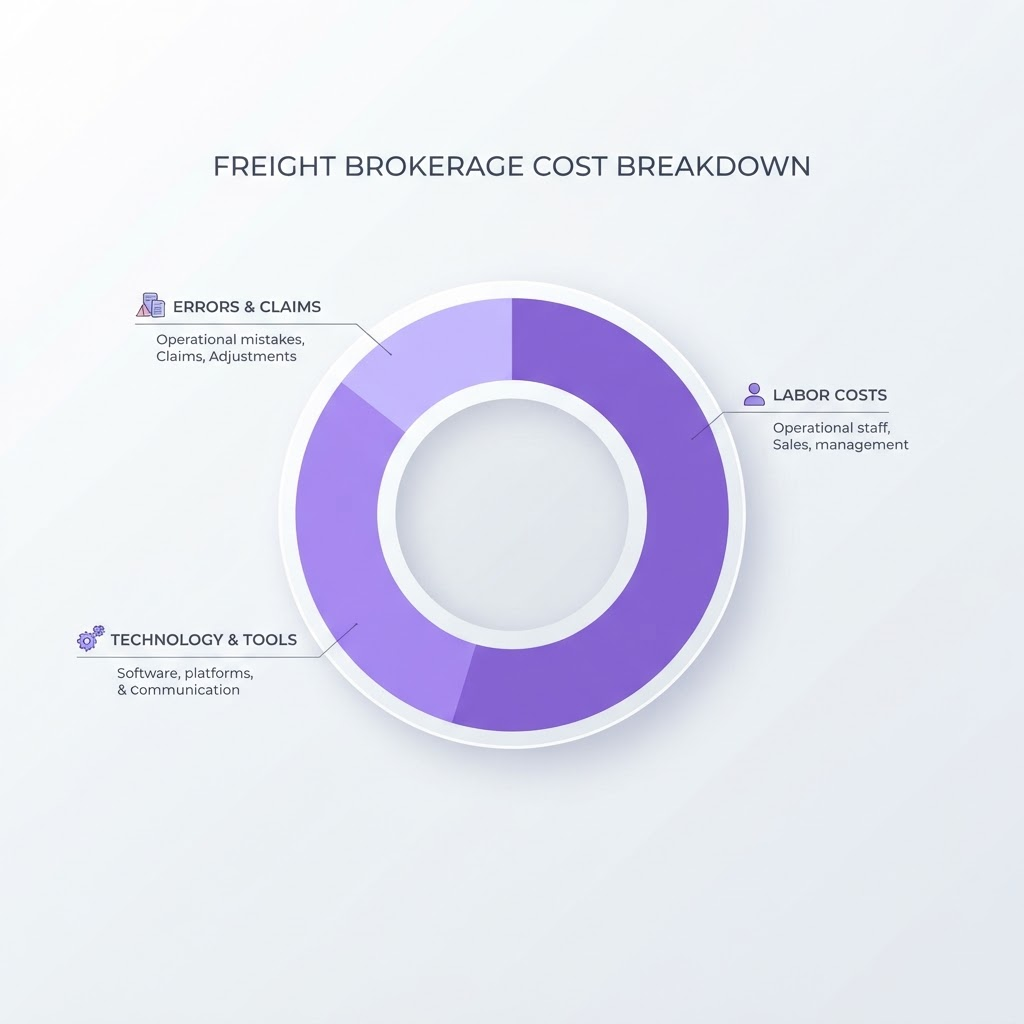
Where freight brokerage operating costs actually go
Before you can cut a cost, you have to see it. For most small-to-mid brokerages, operating cost per load breaks down into three buckets:
- Labor — by far the largest. The reps, coordinators, and after-hours coverage who touch a load from tender to invoice.
- Tools — TMS, load boards, tracking, phones, email, carrier vetting subscriptions.
- Errors and service failures — the invisible bucket: missed appointments, detention you eat, double-brokered loads, billing mistakes, and churned customers.
The mistake most brokerages make is only cutting the second bucket. Switching to a cheaper TMS saves a few dollars per load. Fixing the first and third buckets saves multiples of that.
Lever 1: Lower labor cost per load (without layoffs)
Repeated intake, status collection, and callbacks can consume meaningful staff time, but the amount varies by desk. Use a check-call time audit rather than an assumed industry percentage. Separate routine information capture from the calls that need broker judgment.
The fix is not fewer reps. It's giving each rep more leverage so your existing team covers more freight:
- Hand routine check calls and tracking updates to an agent that never sleeps.
- Let a booking agent cover repetitive, in-guardrail loads so reps focus on relationships and problem freight.
- Automate rate confirmations and appointment scheduling so nobody is on hold with a facility at 4 p.m.
When you spread the same fixed labor cost across more loads, cost per load falls fast. That's the whole game.
The cheapest load you'll ever move is the one your existing team covers without any extra hours. Automation is how you get there.
Lever 2: Kill the cost of errors and service failures
This is the bucket brokerages underestimate most. A single missed delivery appointment can mean detention, a lost customer, and a frantic afternoon of firefighting. A double-brokered load can cost you the entire linehaul plus the freight claim.
These aren't rare edge cases — they're a recurring line item. And most of them trace back to something routine that got missed under load pressure: a check call that didn't happen, a carrier that wasn't properly vetted, an email that sat unread.
Agents attack this directly. A triage agent reads every inbound email and surfaces the real problems before they become claims. A tracking agent flags a late load hours before the appointment, while there's still time to act. You're not just saving labor — you're preventing the expensive failures that quietly eat your margin.
Lever 3: Right-size your tooling — but don't over-index on it
Tooling is the smallest bucket, so it should be the last place you look for savings, not the first. That said, there's real waste here: overlapping subscriptions, seats you don't use, and point tools that don't talk to each other (which creates more manual re-keying labor).
The goal isn't the cheapest stack — it's the stack that removes the most manual work. A tool that costs more but eliminates hours of re-keying is cheaper in total than a "free" one that creates busywork. Evaluate tools by their effect on cost per load, not their sticker price. Our guide to the best freight broker automation software walks through how to make that trade-off.
The cost-reduction framework
You don't need a transformation project. Follow this sequence and the savings compound:
- Measure hours per load. Baseline your current fully loaded cost per load — total operating cost divided by loads moved. You can't improve what you don't measure.
- Automate the highest-volume task first. Usually tracking and check calls — the heaviest manual bucket and the lowest-risk place to start.
- Redeploy, don't eliminate. Move freed-up reps to sales and carrier development, where they generate margin instead of consuming it.
- Add booking on routine lanes. Let the booking agent cover your predictable, in-guardrail freight.
- Turn on triage, then re-measure. Stop service failures before they become claims, then recalculate cost per load and compare.
Put a number on it
The honest answer to "how much can I save" is: it depends on your load volume and how manual your day is today. A brokerage moving 200 loads a week with two coordinators on check calls has far more to gain than a lean shop that's already tight.
Rather than guess, model it. Our ROI calculator lets you plug in your load volume, current headcount, and hourly cost, and estimates the cost-per-load reduction from automating routine workflows. When you're ready to compare the investment against the savings, our pricing is a flat monthly rate with no per-load fees.
The bottom line
You reduce freight brokerage operating costs not by doing less business, but by making each load cheaper to move. Attack labor per load and error costs — the two biggest buckets — with AI agents that absorb routine work, and you lower cost and raise service at the same time. That's the combination that actually compounds.
If you want a candid look at the trade-offs before you commit, read is freight broker AI worth it.
Frequently asked questions
What is a good cost per load for a freight brokerage?
There is no universal benchmark established in this guide. Calculate your own labor, tooling, and attributable service costs over completed loads, use a consistent accounting period, and separate fixed costs from usage-driven costs before comparing options.
What is the biggest hidden cost in a freight brokerage?
Labor spent on repetitive, low-judgment tasks like check calls, data entry, and email triage. It scales linearly with volume unless you automate it, and it is usually far larger than tooling cost.
Does cutting costs with AI mean laying off staff?
No. Most brokerages redeploy staff to sales and carrier relationships instead of hiring more back-office headcount as they grow. Cost per load falls because the same team covers more freight, not because you cut people.
Will reducing costs hurt my service levels?
Done right, the opposite happens. The biggest hidden cost in a brokerage is service failures — missed appointments, late updates, detention. Automating the work that prevents those failures lowers cost and raises service at the same time.
Written by
Priya Nair
Freight Technology Analyst
Priya analyzes logistics software and AI adoption for freight brokerages. She focuses on the practical economics of automation — what actually pays back, what does not, and how to evaluate tools without the hype.
- Logistics technology analyst
- Former TMS implementation lead
- Evaluated 50+ freight software platforms
Related automations
Freight Exception Email Triage Automation for Freight Brokers
Scan the brokerage inbox continuously and escalate only the emails that need action.
Automated Proof-of-Delivery Processing for Freight Brokers
Capture, read, and file every proof of delivery automatically so billing never waits on paperwork.
Carrier Invoice Audit Automation for Freight Brokers
Audit every carrier invoice against the rate con and accessorials automatically.
Keep reading
How Freight Brokers Can Tame Email Overload With AI Triage
Problems hide in a broker’s inbox — detention, rejections, missed appointments. Learn how AI email triage surfaces and escalates the messages that actually need action.
What Is a Tender Rejection in Freight?
A plain-English explanation of freight tender rejections, why they happen, what they cost, and how automated triage keeps a rejected tender from aging into a service failure.
How to Manage Freight Exceptions Before They Become Service Failures
Service failures rarely come from the loads that go well — they come from exceptions buried in a flooded inbox. Here is how to triage detention notices, rejections, and appointment changes before they cost you an account.
Never miss the next freight call.
FastFreight Voice answers as your brokerage office, captures structured freight details, and routes the summary to the right broker while the opportunity is live.