AI Freight Broker Software: How It Works and What to Expect
A complete explainer on how AI freight broker software works — the agents behind it, which tasks it automates, the guardrails that keep it safe, and a realistic 90-day view of what results to expect.
 Priya NairJuly 14, 202611 min readBooking Agent

AI freight broker software has moved from hype to a real operating advantage. Instead of faster spreadsheets, it puts autonomous agents on your desk that handle repetitive work end to end and only pull in a human when judgment is genuinely required. This is a full explainer of how it actually works under the hood, the guardrails that make it safe, and what a realistic rollout looks like month by month.
What AI freight broker software actually is
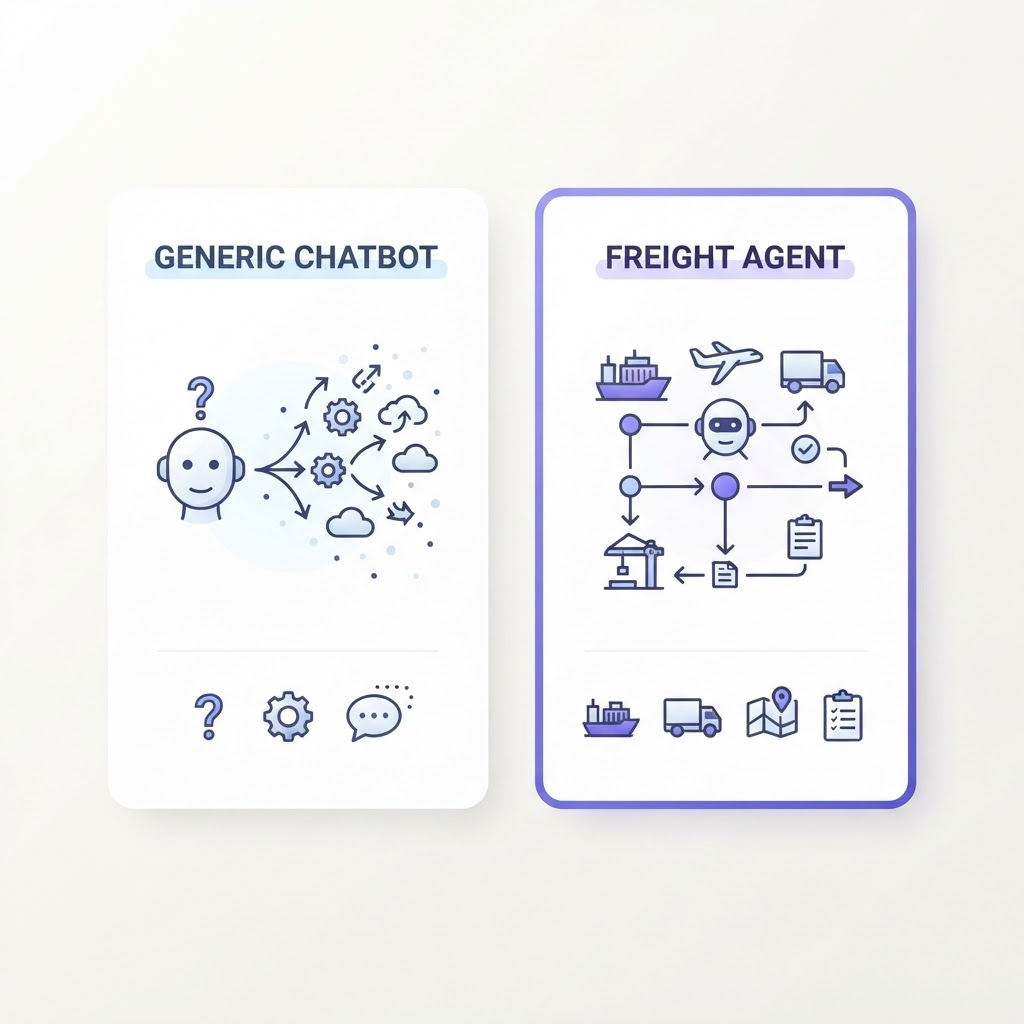
The term covers any software that uses AI agents to run brokerage workflows. The defining capability — the thing that separates it from the "automation" that came before — is that it works on unstructured, real-world inputs. A forwarded tender email, a load-board post, a rate buried in a paragraph: an AI agent reads and interprets these the way a rep would, rather than requiring you to feed it perfectly structured data.
If you want the conceptual foundation, our primer on what an AI agent is in freight is the best starting point, and AI agents vs traditional automation explains exactly why that "interprets ambiguity" property matters so much.
How it works: define rules once, execute at scale
The core idea is simple: you define your rules and guardrails once, then let agents execute them at scale. A well-built platform breaks the brokerage desk into distinct jobs and assigns a specialized agent to each — a multi-agent system rather than one monolithic bot:
- Intake / Dispatch — reads load details from boards and email and writes them into your system as clean records. See AI load building automation.
- Booking — negotiates and books within preset rate, lane, and margin guardrails. See AI load booking automation.
- Tracking — confirms every load is on pace to hit its pickup and delivery windows without manual check calls. See AI freight tracking automation.
- Triage — scans inbound email for problems and escalates the ones that need a human. See freight email triage automation.
Because the agents share context, the booking agent knows what the dispatch agent just intook, and the tracking agent knows what was booked. That shared context is what makes the whole desk feel coordinated rather than like four disconnected tools.
The guardrails that keep it safe
The most common — and most reasonable — objection is "I am not letting software book loads unsupervised." The answer is that good AI freight broker software is not unsupervised; it is bounded. You configure:
- Margin floors — the agent never books below the margin you set.
- Lane and rate rules — acceptable rate ranges by lane, customer, or equipment.
- Approval thresholds — anything above a dollar amount or outside a rule routes to a human.
- Escalation logic — genuine uncertainty is handed off, not guessed at.
Our deep dive on margin guardrails for AI booking walks through how to set these so the agent is aggressive where it is safe and conservative where it is not. The combination of guardrails plus a complete audit trail is what makes autonomy trustworthy: every action is bounded by your rules and reviewable after the fact.
What changes on the desk
The point of AI is not to remove people — it is to remove the busywork that keeps people from selling. After deployment, your reps stop chasing check calls and re-keying load data and start working the exceptions and relationships that actually grow the book. If your inbox is the bottleneck, reducing freight broker email overload shows how triage changes the day.
Your best reps should be negotiating and building carrier relationships, not copying load details between browser tabs.
This is also why AI freight broker software is a lever for growth, not just cost. The same team can cover more freight, which is the whole argument in scaling a brokerage without hiring.
What to expect in the first 90 days
Rollouts follow a fairly consistent arc. Here is a realistic one:
- Weeks 1–2 — Immediate wins. Load intake and check calls are automated first because they are the highest-volume, lowest-judgment tasks. Time savings show up right away.
- Weeks 3–6 — Booking inside guardrails. The Booking Agent starts covering routine freight within your rules while you watch and tune the margin floors and approval thresholds.
- Weeks 7–12 — Mature exception handling. Triage sharpens, overrides become rare, and your team is fully shifted toward high-value work. The agents now run the routine desk and surface only what needs you.
The pace depends on your volume and how clean your rules are going in, but the sequencing — highest-volume tasks first, autonomy earned gradually — holds across brokerages.
Common pitfalls to avoid
- Skipping the guardrail setup. The agents are only as good as the rules you give them. Rushing this is the top cause of a rocky start.
- Automating everything at once. Start with one or two high-volume workflows, build trust, then expand.
- Treating it as rip-and-replace. Keep your TMS. AI freight broker software should layer on, not force a migration.
- No override review. The exceptions your team overrides are a goldmine of tuning signal. Ignore them and the agents stop improving.
Is it worth it for your brokerage?
The honest answer depends on your volume. The more loads you move and the more rep time goes to repetitive tasks, the faster the payback. Run your numbers through the ROI calculator for a personalized estimate, and read our numbers-first breakdown of whether freight broker AI is worth it. For the broader landscape, AI tools for freight brokers surveys the category, and the freight brokerage automation guide shows the booking workflow in depth.
When you want specifics on cost, our pricing is flat and predictable, and you can see the agents working together on the how it works overview.
Frequently asked questions
What does AI freight broker software do?
It uses AI agents to run repetitive brokerage workflows automatically — reading load details, negotiating and booking within your rules, tracking loads, and triaging exception emails — while keeping a human in control of judgment calls. Unlike older automation, it interprets unstructured inputs like forwarded emails rather than requiring perfectly formatted data.
Is AI freight broker software safe to let book loads?
Yes, when it operates inside guardrails. A well-built Booking Agent only books within the rate, lane, and margin rules you set, and escalates anything outside them to a human. The safety comes from the guardrails and the audit trail, not from removing autonomy entirely.
How long does it take to see results?
Most brokerages see time savings in the first weeks because the highest-volume tasks — check calls and load intake — are automated immediately. Booking autonomy and mature exception handling typically follow over the first 90 days as you tune the rules.
Does AI freight broker software replace my TMS?
No. It layers on top of your existing TMS and load boards, reading and writing through them. Your TMS stays your system of record; the AI is the execution layer that acts on that data.
Will AI freight broker software replace my reps?
No. It replaces the repetitive tasks that keep reps from selling — check calls, data entry, inbox sorting — so the same team can move more freight. Most brokerages redeploy people to sales and carrier relationships rather than cutting headcount.
Written by
Priya Nair
Freight Technology Analyst
Priya analyzes logistics software and AI adoption for freight brokerages. She focuses on the practical economics of automation — what actually pays back, what does not, and how to evaluate tools without the hype.
- Logistics technology analyst
- Former TMS implementation lead
- Evaluated 50+ freight software platforms
Related automations
Rate Confirmation Automation for Freight Brokers
Generate, send, and track signed rate confirmations the instant a load is booked.
AI Carrier Rate Negotiation Automation for Freight Brokers
Automate routine carrier negotiation within the exact bands and increments you approve.
AI Load Booking Automation for Freight Brokers
Negotiate and book loads automatically inside your own rate and margin guardrails.
Keep reading
AI Tools for Freight Brokers: What Actually Moves the Needle in 2026
A practical, hype-free breakdown of where AI genuinely helps freight brokerages today — from load intake to booking, tracking, and exception handling.
What Is a Rate Confirmation in Freight? (And How to Stop Chasing Signatures)
A plain-English explanation of what a rate confirmation is, what belongs on one, and how brokerages generate and track signed rate cons automatically instead of chasing carriers by hand.
How to Respond to Freight Quotes Faster (Without Giving Away Margin)
In freight, the first credible quote usually wins the load. Here is how to speed up quote response times without sacrificing pricing discipline — and how AI quotes inside your margin rules automatically.
Never miss the next freight call.
FastFreight Voice answers as your brokerage office, captures structured freight details, and routes the summary to the right broker while the opportunity is live.